Is German manufacturing losing its edge? The latest casualty of the US-China strategic rivalry
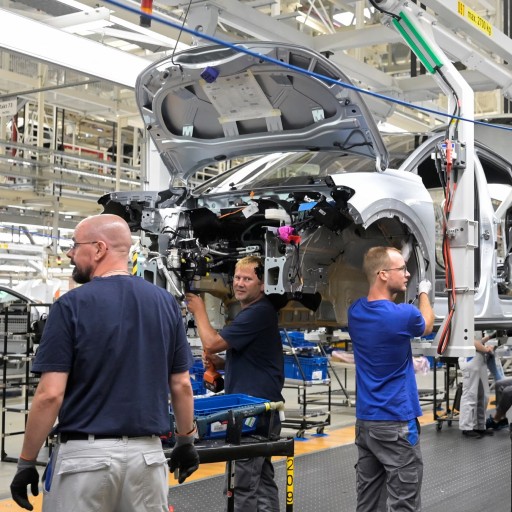
Once upon a time, “Made in Germany” was synonymous with quality, efficiency, and engineering innovation. From Mercedes-Benz and BMW to Siemens and Bosch, from precision machinery to chemical raw materials, German industry has underpinned Europe's status as a major export powerhouse.
However, as the strategic rivalry between China and the US intensifies, the once-glorious “Made in Germany” brand seems to be quietly fading. Capital markets are beginning to question: Is Germany becoming the “new casualty” of this geopolitical and supply chain restructuring?
Is the golden age of manufacturing fading away?
Germany's economy has long been highly dependent on manufacturing exports. According to OECD data, manufacturing accounts for over 20% of Germany's GDP, second only to South Korea among developed nations.
Industries such as automobiles, machinery, chemicals, and electrical equipment dominate Germany's foreign trade structure. China and the US are precisely the two most important markets for German goods.
Following China's accession to the World Trade Organization in 2001, German manufacturing entered a “honeymoon period” in the Chinese market.
China's infrastructure development, industrial upgrading, and urbanization process created strong demand for Germany's high-end equipment, leading to surging sales of Mercedes-Benz and BMW vehicles, while Siemens and BASF also established multiple large-scale production bases in China.
However, this situation began to reverse after 2018. With the outbreak of US-China trade friction, global supply chains began to fragment, the US pushed for “de-Chinaization,” and domestic manufacturing began to return. Germany, as a traditional ally of the United States, was inevitably drawn into this geopolitical struggle.
Any trade restrictions, technology export controls, or investment reviews between China and the United States would indirectly impact German manufacturing companies.
After 2023, the rapid rise of Chinese manufacturing began to directly compete with Germany in the mid-to-high-end product segments. Traditional “German strengths” such as new energy vehicles, batteries, machine tools, and robots now face “Chinese alternatives.” The current situation is no longer one where “China needs Germany,” but rather “China can replace Germany.”

Export Dilemma and Escalating Supply Chain Risks
In 2024, Germany's exports to China declined by 7% year-on-year, particularly in the machinery and automotive sectors. Meanwhile, German manufacturing companies' exports to the US also saw weak growth, as US domestic industrial policies favor domestic manufacturers or supply chains from “friendly nations.”
Against this backdrop, German industry has frequently warned that “Germany is being squeezed out of the dual market structure dominated by China and the US.” The German economic model, which previously relied on global free trade and cross-border investment, now faces systemic challenges.
Moreover, fluctuations in raw material prices and rising energy costs are placing significant pressure on German manufacturing. Following the outbreak of the Russia-Ukraine conflict, Germany lost access to relatively cheap Russian natural gas, and the short-term pain caused by the energy transition began to affect factory utilization rates and cost structures.
In terms of supply chains, many German SMEs rely on component supplies from Eastern Europe or Asia, but geopolitical tensions have significantly reduced the stability of cross-border logistics and trade. Raw material delays, order cancellations, and soaring transportation costs are gradually eroding corporate profit margins.
A recent report by Commerzbank noted that Germany's manufacturing PMI has been below the boom-bust line for several months, manufacturing capital expenditure is contracting, and investment sentiment has significantly declined. Factories are not unwilling to expand, but rather dare not expand.
“Third-party damage” in technological decoupling
Technological decoupling, especially the US-China confrontation in semiconductors, high-end equipment, and artificial intelligence, is also becoming a major negative factor suppressing German manufacturing.
German industrial automation and high-precision machinery rely on certain U.S.-produced core software and hardware components, such as EDA tools, sensors, and industrial embedded systems. Meanwhile, these German products are exported to Chinese electronics and automotive factories.
If the U.S. were to ban the re-export of these German products' technologies, German companies would face a dilemma: they cannot afford to lose U.S. support while also risking the Chinese market.
For example, some German machine tool manufacturers have been forced to abandon orders from specific Chinese companies due to components subject to U.S. export restrictions. Over time, this not only leads to customer loss but also erodes the neutral commercial reputation of German manufacturing.
Additionally, China's domestic substitution policies are intensifying, with domestic brands emerging in sectors such as high-speed rail equipment, medical devices, and high-end CNC machine tools. Even without explicit “technology embargoes,” German companies are being “marginalized” by the policy tilts and protectionism of both the US and China.
Capital markets cast a vote of no confidence in “German manufacturing”
International capital markets are reassessing the future value of German manufacturing companies. In 2024, the DAX index underperformed U.S. stocks and most Asian markets, with shares of automotive giants like Volkswagen and Daimler experiencing significant volatility.
Especially, the massive investments required for the transition to new energy are putting pressure on corporate cash flows, while the market remains cautious about the effectiveness of these transitions.
Meanwhile, Chinese electric vehicle brands (such as BYD) and technology companies are expanding into Europe, directly challenging Germany's domestic market share. The moat protecting German manufacturing is being breached.
Capital is even more concerned about Germany's strategic ambiguity within the global financial order. On one hand, Germany aligns politically with the US; on the other, it heavily relies on the Chinese market.
This dual dependency makes Germany's economic strategy inconsistent, leading to indecision in policy-making and a dilemma of being stuck between a rock and a hard place. Foreign capital dislikes ambiguity and risk.
Additionally, the EU's unified fiscal and monetary policies make it difficult for Germany to independently implement fiscal stimulus measures or adjust exchange rates.
In response to the current manufacturing downturn, the German government has introduced measures such as the “Industrial Subsidy Program” and “Tax Cuts to Boost Exports,” but their effects have been limited. Foreign investors cannot see a “strong policy signal,” so they will not continue to bet on the recovery of “German manufacturing.”
The Next Step for German Manufacturing: Reconstruction and Transformation?
Is German manufacturing really heading toward decline? Not necessarily. But it is certain that it needs a profound structural restructuring.
First, Germany must reassess its economic model, which is overly reliant on exports, particularly to China and the US. Economic growth should rely more on domestic innovation and the technology value chain, rather than low-cost processing and trade dividends.
Second, Germany should accelerate breakthroughs in fields such as artificial intelligence, green energy, and quantum technology to find new “industrial moats.” These fields are not yet dominated by China and the US, and may present an opportunity for German manufacturing to make a comeback.
Third, financial market reforms must not be overlooked. Germany's capital markets are less developed than those of the US, and its innovative enterprises have limited financing channels. To support the growth of new industries, Germany needs a more open and risk-controlled financial ecosystem.
This includes strengthening the VC/PE ecosystem, optimizing the IPO system, and increasing the risk tolerance of domestic financial institutions toward manufacturing innovation.
Finally, there is the need for a political and geopolitical repositioning. Germany requires a more resolute and pragmatic diplomatic strategy to maintain rationality and balance between the US and China, striving for the greatest possible autonomy. If it cannot independently safeguard its industrial interests, the decline of “German manufacturing” will only accelerate rather than ease.
The decline of German manufacturing is not a simple cyclical adjustment issue but a “systemic shift” under the restructuring of the global landscape. As “de-globalization” and “geopolitical rivalry” become the dominant themes of the era, nations and industries that have relied on the benefits of free markets must make difficult choices.
Between the US and China, if Germany's industrial and financial strength cannot swiftly restructure its framework and strategy, its advantages are not merely being lost but are being “replaced.” This is not only a challenge for “Made in Germany” but also the prelude to the collapse of an entire global industrial logic.
 1
1 1
1OTHER NEWS
-
- Do small businesses really need tax services? When can they file their own taxes?
- By YCY 27 Jan,2026

-
- What do you Mean by Mortgage? What Does it Mean to Have a Mortgage?
- By Little Grapes 24 Apr,2023

-
- How much longer can the eurozone hold out? The ECB has reached the end of its rate hike cycle
- By ZXY 01 Aug,2025

-
- Real Estate Investment Needs to be Careful!
- By Little Grapes 24 Apr,2023

-
- Should you Choose a Real Estate Agent When Buying a Home?
- By Wendy 24 Apr,2023

-
- Who is the Primary Lender When Applying for a Home Loan? These Points are Important!
- By Little Grapes 24 Apr,2023

-
- How to Effectively Manage Debt: Strategies for Balancing Payments and Savings
- By YCY 07 Jan,2026

-
- How do I Choose Between Selling my Home and Renting it out?
- By Wendy 24 Apr,2023

-
- Fixed deposits are not as good as flexible financial management? Analysis of financial management trends in 2025
- By ZH 24 Jul,2025

-
- With China's exports declining, is the global consumption chain beginning to break?
- By ZXY 31 Jul,2025
-
- High-yield stocks vs. growth stocks: Which type of investment is more resistant to risks? A game of wealth defense and offense
- By ZH 23 Jul,2025

-
- Mobile phone is the bank: one-click account opening, one-click financial management, digital financial life is coming
- By ZH 24 Jul,2025